Spring frost is not an exceptional occurrence. It is a structural, recurring risk that affects thousands of hectares in France every year. And how it is managed directly impacts the harvest.
Late frost: When does it occur, and which crops are affected?

Spring frosts generally occur between March and mid-May, at a time when plants have already begun their growing season. Buds have burst open, and flowers are beginning to bloom: crops are at their most vulnerable stage.
Vines are particularly vulnerable. As soon as budbreak occurs, the young shoots cannot withstand temperatures below a few degrees below zero. Fruit trees—peach, apricot, pear, and apple trees—suffer the same damage to their flower buds. A late frost affects vineyards in Burgundy, Champagne, and the Loire Valley just as much as it does the large orchards of the Rhône Valley.
What economic losses can a night of frost cause?
A single uncontrolled night of frost can result in the partial or total loss of a crop. For some farms, this represents tens of thousands of euros in lost revenue, not to mention the indirect costs associated with crisis management.
Episodes of late frost recur year after year, sometimes lasting several consecutive nights. This recurrence forces growers to mobilize significant human and material resources every spring, regardless of the protective measures they choose.
How does an antifreeze candle work?
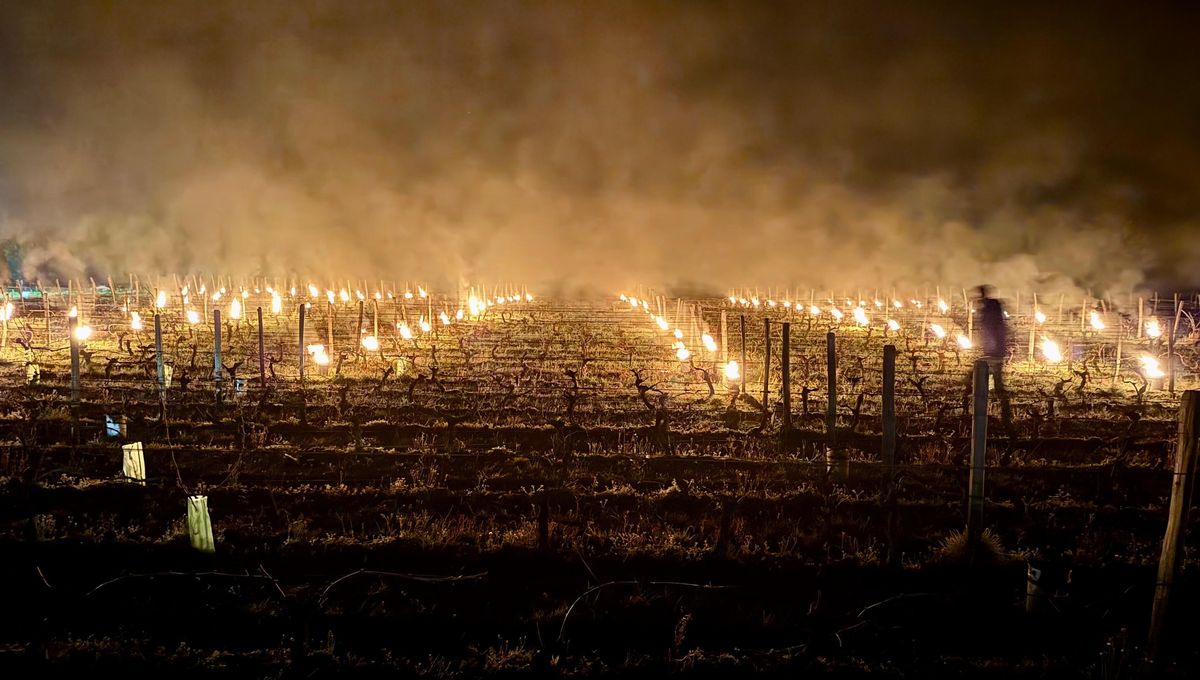
The anti-freeze candle generates heat through the slow combustion of a mixture made from vegetable wax or paraffin. This heat radiates around the fire and warms the layer of air near sensitive plant parts. It does not radiate heat upward, but rather at ground level, where buds and flowers are exposed to the lowest temperatures.
Modern formulations incorporate more environmentally friendly ingredients, reducing smoke production and soot emissions. The burn time of a standard antifreeze candle is generally between one and two nights, depending on the formulation, weather conditions, and how well the product is maintained.
Which crops are affected: grapevines, fruit trees, citrus trees?
The anti-frost candle can be used on a wide range of crops susceptible to late frost. Grapevines are by far the most affected: as soon as budbreak occurs, the young shoots are extremely vulnerable to subzero temperatures, even mild ones. Orchards of pome fruits (apple and pear trees) and stone fruits (peach and apricot trees) face the same risk during flowering. Citrus trees, although concentrated in milder climates, can also be protected by this system during unusual cold spells.
Farmers such as those at Les Vergers de l’Île or the La Roche de Glun estates face these risks every spring with crops of high economic value, where every unprotected night of frost can directly impact the harvest.
Conditions for Effective Protection from Candles
The effectiveness of an anti-icing candle system depends on several demanding operational conditions. Thermal coverage is only effective if there is a sufficient density of candles on the ground. Insufficient deployment leaves cold spots between the heat sources, resulting in only partial protection.
From a logistical standpoint, the deployment requires a significant workforce: the candles must be placed on the plot before the frost sets in, lit at the beginning of the night, monitored as they burn, and replaced during the night if the frost persists. This operation requires a constant human presence throughout the entire protection period.
Ultimately, effectiveness depends as much on the quality of the supplies as it does on the rigor of on-site management.
How does the Ventigel system work?
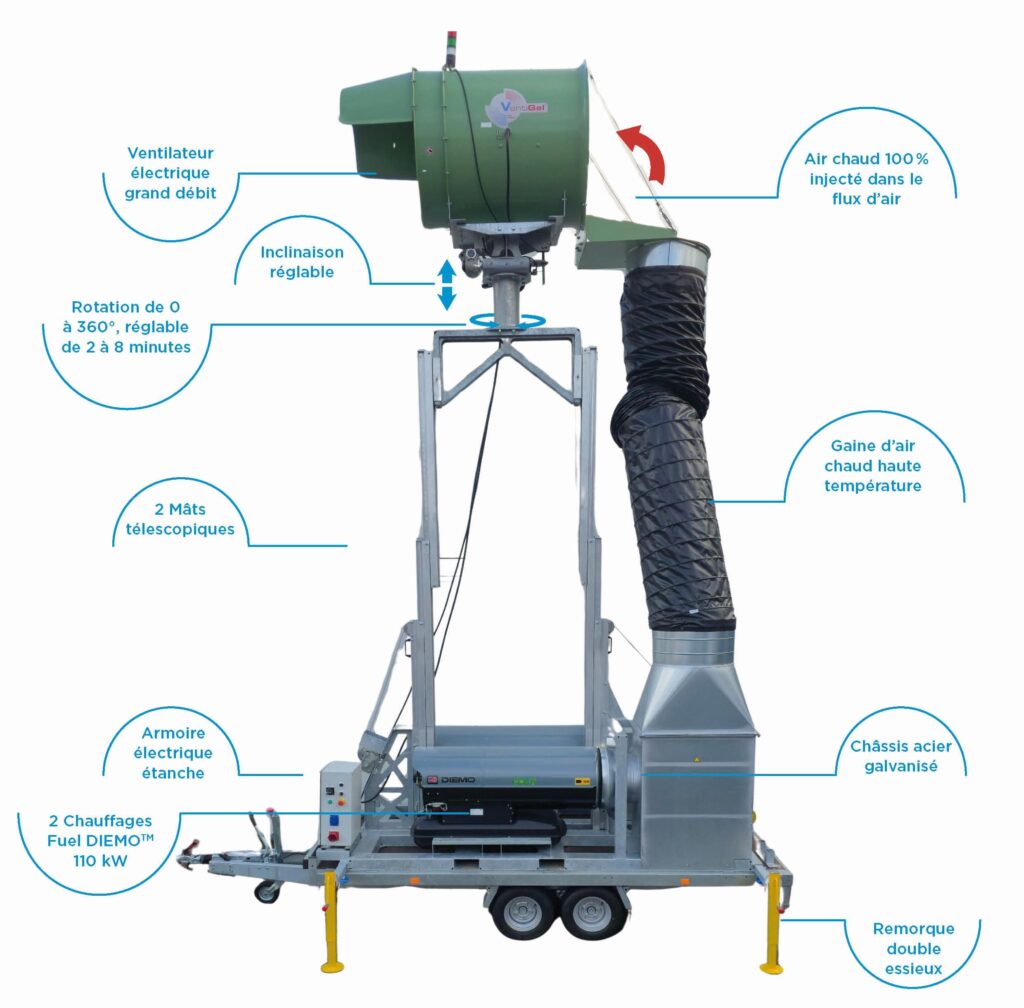 The Ventigel Tower (or anti-frost tower) operates on a different principle than candles: it combines powerful air circulation with an onboard heating system to create a thermal blanket over the plot. The hot air produced is continuously distributed and circulated, which evens out the temperature around sensitive plant parts rather than creating multiple localized hot spots on the ground.
The system is mobile, allowing it to be repositioned as needed from season to season or based on priority plots. Its French manufacturing and design, tailored to real-world operating conditions, make it robust enough to withstand the demands of the field.
The operating cost per night is controlled and stable, with no expenses for consumables that need to be replaced. Annual maintenance is minimal, which greatly simplifies long-term management.
An investment that pays for itself in 2 to 3 years: How can you make that happen?
The initial investment in a Ventigel is higher than buying a batch of candles for a single season. This is the primary concern cited by operators who are interested in it. But the calculation changes when you look at it over several springs.
Candles represent an expense that starts from scratch every season: consumables that must be repurchased in full, nighttime labor that must be mobilized night after night, and on-call schedules that must be reorganized for each incident. The operating cost of the Ventigel, on the other hand, remains stable from year to year, with no consumables and minimal annual maintenance.
Over a 2- to 3-year period, the comparison clearly favors the mechanized system, even when using the assumptions most favorable to the manual method. And even without factoring labor costs into the equation, the tipping point is reached quickly.
The environmental aspect rounds out the picture: no smoke, no combustion residue, and no waste from consumables. This is an additional selling point that is becoming increasingly important for appellations concerned about their image.
Financing and Assistance: Making Investment Accessible
The initial investment is not necessarily a deal-breaker. Tailored financing options allow you to spread out the purchase cost, making the comparison with candles even more favorable starting in the first season of use.Tax depreciation allowances for the equipment further reduce the actual impact on the farm’s cash flow.
For winegrowers who would like to learn more about frost protection for vineyards, it is possible to evaluate the solution by taking into account the specific characteristics of each vineyard.